Teachers Say Cell Phones Are a Problem. Parents Say Phones Are Essential. They Are Both Right.SBC issues White Paper that examines multiple facets of this hotly debated issue. IWCE session and Survey dive even deeper.
By John Foley, Managing Director, Safer Buildings Coalition Executive SummaryThe reasons schools are restricting cell phones are valid. Research confirms what teachers have been saying for years: phones are a serious classroom distraction, and excessive use is linked to anxiety, depression, and cyberbullying among young people. More than 20 states have implemented bans or significant restrictions, and 72% of high school teachers identify cell phones as a major problem in the classroom [Hatfield24]. These concerns are real, and they deserve real solutions. But the way we’re solving the problem is creating new ones. Suspensions more than doubled in one large Florida district during the first month of enforcement [Figlio25]. Teachers are spending instructional energy policing devices instead of teaching. Parents—78% of whom want their children to have phone access for school emergencies [NPU24]—are largely being excluded from these decisions, with only 30% reporting they were even consulted [NPU24]. And when policies require students to lock phones in pouches or store them in lockers, the one communication channel that might work in a crisis is taken off the table. There is broad agreement that distraction is a problem worth solving. But support drops sharply when the solution extends beyond the classroom. Polling shows 74% of adults support restricting phone use during class time—but when the restriction covers the entire school day, support falls to 44% [Pew25]. Students show the same pattern: 60% support classroom restrictions, but only 10% support bell-to-bell policies [RAND25]. The consensus isn’t about whether to act. It’s about how. The tension between restricting a technology and preserving its benefits isn’t new. When the FAA and FCC banned cell phone use on aircraft—the FAA over concerns about avionics interference, the FCC to protect ground networks—phones had to be completely powered off. Passengers who wanted to use non-transmitting features like music or games had no option. Enforcement fell to flight attendants.
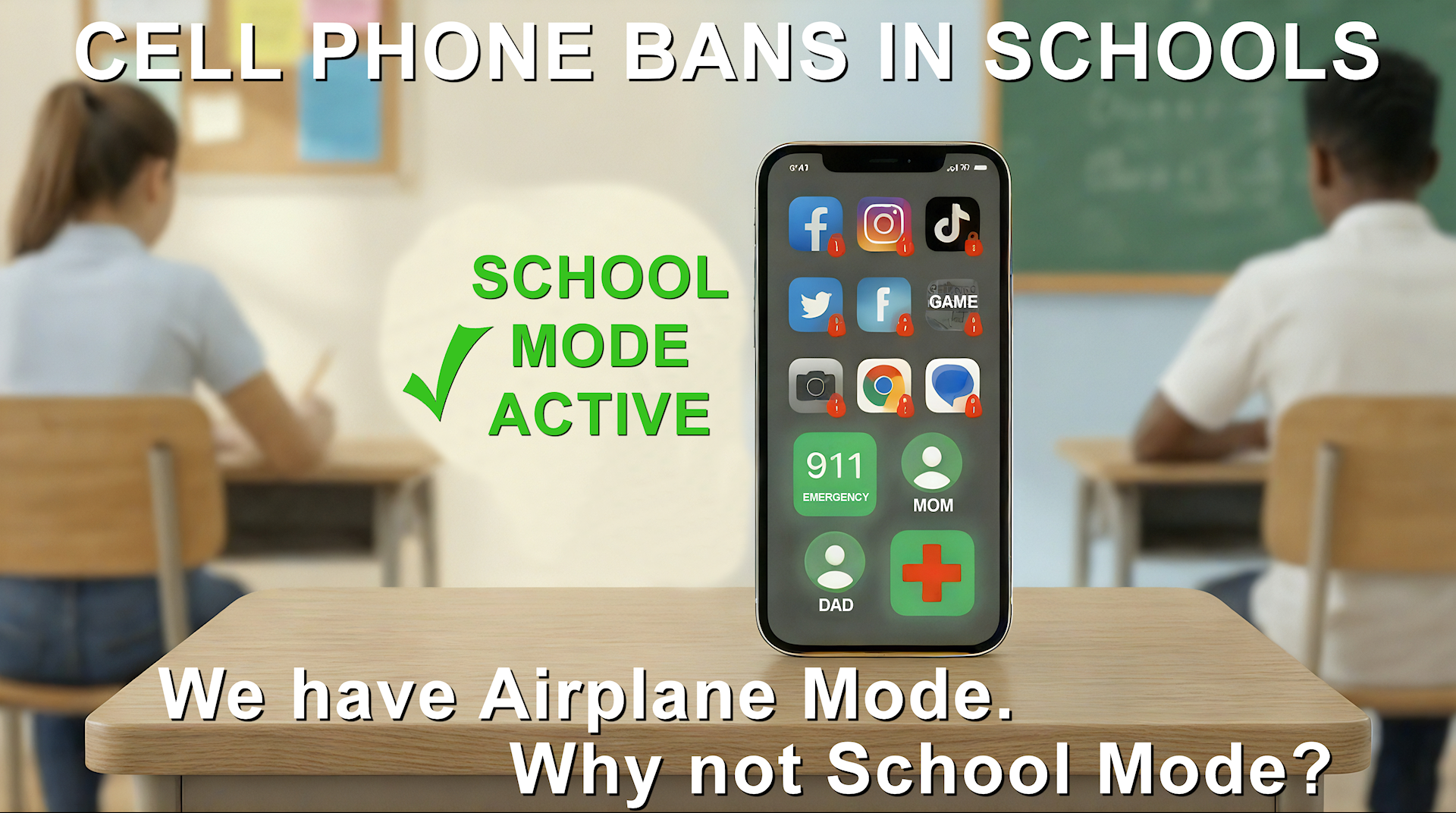
Airplane Mode gave passengers a way to comply without giving up their devices entirely. Instead of powering off, they could disable transmissions while keeping the features they wanted. It wasn’t automatic—users still had to activate it—but it replaced a blunt restriction with a targeted one, and it moved enforcement from confrontation to a simple toggle. No confiscation. No one serving as phone police. And no one questioned whether the industry had done the right thing. That was the best available solution twenty years ago—a manual toggle that relied on users to activate it. Today we have precision GPS, geofencing, cloud-based policy management, and context-aware automation. If Airplane Mode were being designed today, no one would propose a manual switch and hope for compliance. They would build something smarter—something that activates automatically based on where you are and what the rules require. That is what School Mode could be. What Is School Mode?At the Safer Buildings Coalition, we’ve released a white paper proposing “School Mode for Cell Phones”—a technology framework that would restrict cell phone functionality during school hours while preserving emergency communication. Like Airplane Mode, it would be built into the device’s operating system. Unlike Airplane Mode, it would not depend on anyone choosing to turn it on. The concept is straightforward. The device would use two criteria working together: Is the phone on school property? And is it during school hours? Both conditions must be met. School Mode would only activate when a student is actually at school during the school day—not on weekends, not after hours, not during summer break, and not when students leave campus for lunch or activities. When either condition is no longer met, normal functionality returns automatically. While active, School Mode would block the apps and functions that cause classroom distraction—social media, games, messaging with friends—while keeping the capabilities that matter: 911 calling, parent communication, medical monitoring apps, and school-approved educational tools. Schools would configure restrictions to match their own policies. Teachers could adjust settings for classroom activities. Different grade levels could have different rules. What Makes This DifferentCurrent approaches ask humans to enforce phone restrictions. School Mode would let technology do that work instead—completing the shift that Airplane Mode began but couldn’t finish with the technology available at the time. With bans and pouches, teachers become enforcers—spending instructional time on compliance rather than teaching. Students face suspensions and confrontations over device possession. Parents lose the ability to reach their children, even in urgent situations that fall short of a full emergency: a custody issue, a medical update, a sudden change in after-school plans. Routing these communications through school administration introduces delay and removes privacy for sensitive family matters. With School Mode, technology handles enforcement consistently and automatically. Teachers teach. Students keep their phones but can’t access distracting apps. Parents can still reach their children directly when it matters—without explaining why to the front office. Three principles are non-negotiable: First, participation would be a family decision: always opt-in, never mandated. Second, emergency access is absolute: during any crisis, all restrictions are immediately overridden, ensuring students can reach 911 and parents can reach their children. The system would integrate with FEMA’s Integrated Public Alert and Warning System (IPAWS) and other emergency notification systems to trigger automatic override. Emergency SOS capabilities built into the phone’s hardware remain available regardless of School Mode restrictions, and newer models support satellite-based emergency signaling when terrestrial networks are unavailable. When emergency conditions are detected, School Mode would surface clear SOS activation instructions on the lock screen—ensuring every student knows how to reach help at the moment it matters most. Third, schools control their own policies: School Mode provides the enforcement mechanism, not the rules. When Cell Phones Are the Last Line of CommunicationThere is a dimension to the school phone debate that receives too little attention: in-building wireless reliability during emergencies. Public safety radio systems and commercial cellular networks do not always provide the same coverage inside buildings. Building materials—concrete, steel, low-emissivity glass—block radio waves. This is not theoretical. At Robb Elementary School in Uvalde, Texas in 2022, first responders’ radio systems failed inside the building. Students’ cell phones did not. Texts and calls from trapped children provided the situational awareness that the emergency communication infrastructure could not deliver.
This is not an argument against addressing phone distraction. It is an argument for solving it in a way that preserves the emergency communication capability that students, parents, and first responders may depend on. Why This Doesn’t Exist YetOnly the predominant mobile device platform providers can build this. It requires operating system-level integration—not an app, not a workaround, but a fundamental device capability, just as Airplane Mode is. Our white paper outlines detailed technical specifications including cloud-based architecture with open APIs, robust security protocols, and integration with existing family management and education management platforms. The mobile device industry solved the airplane problem two decades ago because there was clear demand and a clear path. The same conditions exist today in schools—but platform providers need evidence that communities want this before committing to development. They need to know: Do parents want this? Do educators see value in it? Would schools adopt it? Would it address the problems communities are actually experiencing? Those are not questions we can answer for them. Only you can. Why the Safer Buildings Coalition Is Proposing ThisThis might seem like an unusual proposal from an organization focused on in-building communications. It’s not. Founded in 2012, the Safer Buildings Coalition works to ensure reliable emergency communications inside buildings where wireless connectivity is often unreliable. Our “9-1-1 Inside” mission reflects a simple principle: emergency communication should work regardless of where you’re standing. According to the FCC, a one-minute improvement in emergency response time could save nearly 14,000 lives annually in the United States [FCC24]. That is why we believe the school phone debate cannot be separated from the question of emergency communication—and why we are proposing a solution that addresses both. We Need to Hear From YouThe precedent is there. The technology is there. What’s missing is your voice. We are seeking input from parents, students, teachers, administrators, IT professionals, public safety officials, and policy makers. Whether you think this framework would help, whether you have concerns about it, or whether you’re simply uncertain—your perspective matters. Our survey examines current cell phone policies, whether opt-in technology options would address real needs, and what concerns they raise—including privacy, reliability, circumvention, costs, and equity. If feedback indicates this framework could address unmet needs, we will present that evidence to platform providers, state education officials, and national education organizations. Our white paper proposes a 2027 academic year deployment following pilot programs, but any timeline depends entirely on demonstrated community interest and platform provider commitment.
Join the Conversation at IWCE 2026We will explore these questions at the International Wireless Communications Expo in Las Vegas, March 16–19, 2026. The session “Cell Phone Bans in Schools: Exploring Alternatives to All-or-Nothing Solutions” brings together perspectives that are often in tension: educators who see phones as detrimental to learning and parents who see them as essential for safety. Panelists include:
The session will be moderated by Eric Toenjes, Board Sponsor of the SBC School Safety Work Group. For more information: www.saferbuildings.org | [email protected]
References [FCC24] Federal Communications Commission, Location-Based Routing for Wireless 911 Calls, Report and Order, PS Docket No. 18-64, FCC-CIRC2401-02, at para. 2, n.4 (Jan. 4, 2024). [Figlio25] Figlio, D. N., & Özek, U. (2025). The impact of cellphone bans in schools on student outcomes: Evidence from Florida (NBER Working Paper No. 34388). https://www.nber.org/papers/w34388 [Hatfield24] Hatfield, J. (2024, June 12). 72% of U.S. high school teachers say cellphone distraction is a major problem in the classroom. Pew Research Center. Link [NPU24] National Parents Union. (2024, September 6). In case of emergency: New survey finds why parents say children should have their cell phone at school. Link [Pew25] Gottfried, J., Park, E., & Anderson, M. (2025, July 16). Americans’ support for school cellphone bans has ticked up since last year. Pew Research Center. Link [RAND25] Diliberti, M. K., et al. (2025, October 7). Principals see many benefits of cell phone policies, but youth remain skeptical. RAND Corporation. Link |